

Nanolex Si3D: The Coating We Install, Explained
Most of the questions I get about ceramic coatings come down to one thing. People want to know what they are actually paying for. The word ceramic is on a two dollar car wash add on, on a spray bottle at the parts store, and on the jobs we do here with two days of correction under them. Same word, three very different things. That confusion is fair, and it is worth clearing up before you spend money on a bottle.
So I am going to explain coatings using the one we actually install. We have been a Nanolex certified installer for years, and Nanolex Si3D is what goes on customer cars in the shop. It is also the bottle I hand people when they want to coat their own car properly, because it is the same product, the same prep, and the same method.
This post covers what Si3D is, what a ceramic coating actually does on a car, how we apply it in the bay, and what it needs from you afterward. By the end you will know whether it belongs in your garage or whether one of the simpler Nanolex products is the better fit.
What Nanolex Si3D is
Si3D is built on organic polysilazane technology. Once it cures it forms a cross linked, three dimensional matrix on top of the clear coat. Nanolex describes the result as a several micron thick clear coat with a color darkening effect, and that is exactly what it looks like on the car. Dark paint gets deeper. Metallics get a wetter reflection. It is a real optical change, not a trick of a fresh wash.
The matrix is dense, and that density is the point. Nanolex rates the coating as highly resistant to abrasion and to the chemical attack that comes from frequent washing, which is what kills most protection on a daily driver. The polymers are free of aromatic solvents and free of fluorine. One layer is all it takes to get the full result. It is developed, tested, and manufactured in Germany.
We stock it in two sizes. The 50 ml bottle is $79 and covers a normal car with enough left for a second car or the wheels. The 30 ml bottle is $69 and does one car.
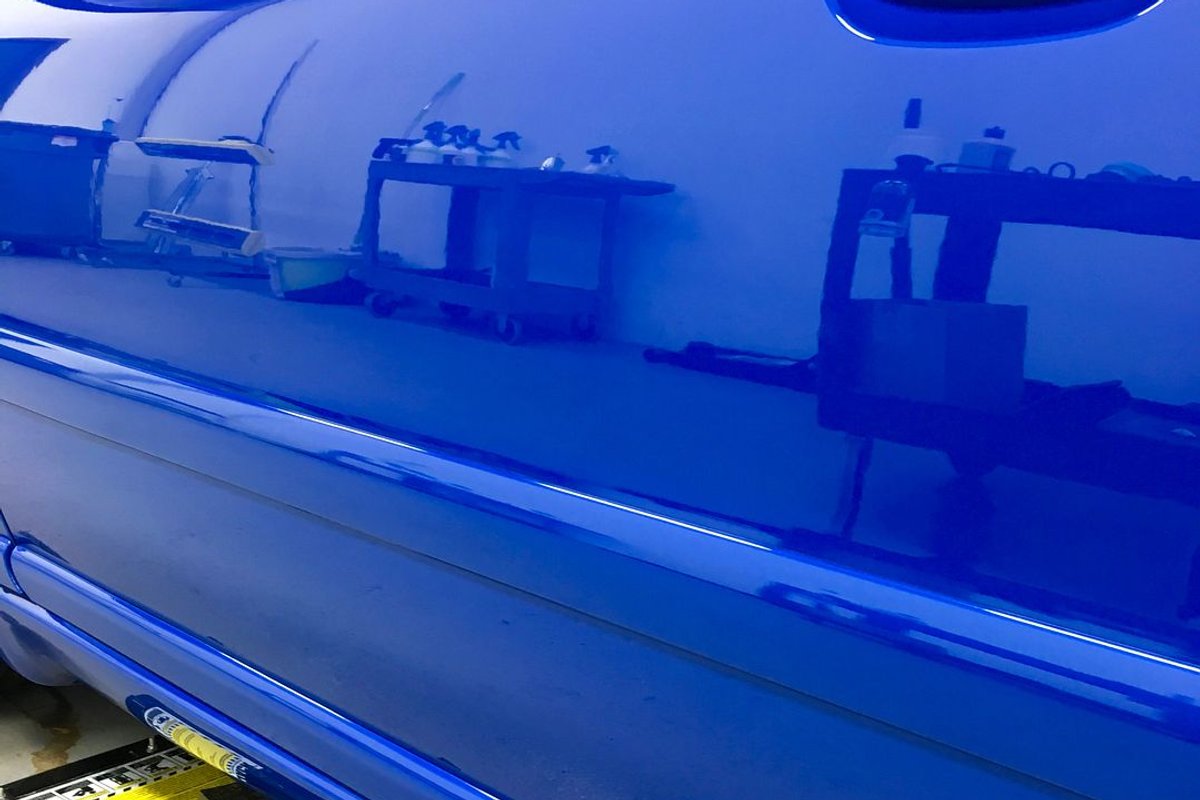
What does a ceramic coating actually do
A ceramic coating is a liquid that cures into a thin, hard, transparent layer bonded to your clear coat. Once cured it becomes the surface of the car. Water, road film, bird droppings, and wash chemicals touch the coating first. Your paint sits underneath.
Three things follow from that. The first is chemical resistance. The clear coat on a modern car is durable but it is still a plastic, and it slowly gives ground to acidic bird droppings, bug remains, and harsh wash chemicals. A coating with real chemical resistance takes that abuse first.
The second is water behavior. A cured coating has very low surface energy, which is a technical way of saying water does not want to stay on it. Rain beads and runs off. Road spray sheets away at speed. Dirt has a harder time bonding to the surface, so the car stays cleaner between washes and comes clean with less contact when you do wash it. On a coated car the mitt glides. On an uncoated car it drags. That difference is a large part of why coated cars pick up fewer wash swirls over the years, and Nanolex's phrase for it, a much easier to clean surface, is the plainest way to say it.
The third is gloss and depth, the color darkening effect I mentioned above. On a black or dark blue car it is the first thing people notice.
What a coating does not do also matters. It is not paint protection film. A coating will not stop a stone chip, a shopping cart, or a key. It is measured in microns, and it will pick up wash marring if you wash the car badly. Think of it as a hard, slick, sacrificial skin that makes the car easier to own. If your goal is impact protection, film is the answer, and we do both in the shop.
How we apply Si3D in the shop
Coatings are only as good as the surface under them. A coating locks in whatever it is applied over, so any swirl or hologram in the paint gets sealed under a hard layer for years. That is why every coating job in our shop starts with paint correction. I wrote about this at length in why even fresh paint needs correction and a coating, using my S4 the week it came back from the paint booth. That car got Nanolex.
Once the paint is corrected, the panel has to be chemically clean. Polishing oils and fillers sit in the paint and stop the coating from bonding. We wipe every panel with Nanolex EX, a non abrasive surface cleaner that removes oils, polish residue, fillers, and fats and leaves nothing behind. Nanolex makes the prep product and the coating, which is one of the reasons the shop chose the line. When a coating fails early, the cause is nearly always prep, and a system where the prep cleaner and the coating come from the same chemist removes a variable.
Application is a few drops on a suede wrapped around an applicator block, spread across a section about half a hood in size in overlapping passes, then leveled with a clean microfiber. One layer. Work in good light, move around the car in sections, and check each one from an angle before moving on. If you see a streak or a high spot, wipe it again with a fresh towel while the coating is still workable.
Keep the car inside and dry overnight. We tell customers to keep it away from water for 24 hours and to skip the first wash for a week.
Base coat, top coat, and the coating above it
Si3D on its own is a complete coating. For customers who want more, Nanolex builds the line to stack. Si3D BC is the base coat, an extremely dense inorganic polysilazane layer that is very hard and, unusually for a glass coating, flexible. It is made for layering, its carriers are safe on freshly painted cars and sensitive paint, and Si3D goes over it as the top coat. That is the two layer system we use on cars that just came out of a booth.
Above both of those sits Si3D Cerabide, a silicon carbide reinforced matrix rated at 75,000 km and more, with a water contact angle Nanolex puts at 105 degrees and above and a level of scratch resistance the regular coatings do not reach. It is $199 for 30 ml and it is what we recommend when someone wants the most from a single layer.
Maintaining a Nanolex coating
A coating changes how you wash the car. Most of the dirt comes off with the pre rinse and the foam, and the mitt is doing very little work. Use a pH neutral shampoo and a two bucket wash. Dry the car fully, because water spots etch into a coating the same way they etch into paint.
Two Nanolex products keep the coating working the way it did on day one. WashCoat goes on the wet car at the end of a wash through a foam lance or pump sprayer, bonds to the surface, and refreshes the protection already there. Rinse it within three minutes and it is cured by the time you rinse. Nanolex rates each treatment at roughly 2,000 km, so every few washes is plenty. Si3D Spray is the other option, a water based spray coating with no cure time, rated at 10,000 km or 10 washes, for the car you do not want to park for a day.
Winter is where a coating earns its keep in this part of the country, and it is also where people neglect it. I covered the full routine in driving a coated car through a New Jersey winter. The short version is that road salt sitting on a coating for weeks is still a problem, so rinse the car when you can.
The first year with a coating, stop by stop
Here is the aftercare schedule we hand customers when a coated car leaves the shop. Tap a stop on the timeline.
The first 24 hours
Do this
Keep the car inside and dry overnight. Walk around it in good light one more time and wipe any high spot you missed while the coating is still workable.
Avoid this
Water of any kind. Rain, dew, a sprinkler, a rinse. The coating is still bonding to the clear coat and water this early leaves marks that are hard to remove.
The first week
Do this
Drive the car normally. If a bird gets it, blot the spot with a damp microfiber and leave the rest alone. The coating keeps hardening for several days.
Avoid this
Washing, waxing, or any chemical on the paint. Skip the first wash for a full week, even if the car looks dusty.
The first month
Do this
First proper wash. Pre rinse, foam, two buckets, a pH neutral shampoo, and a full dry. You will notice the mitt glides and most of the dirt left with the rinse.
Avoid this
Automatic car washes with brushes, dish soap, and letting the car air dry in the sun. Water spots etch into a coating the same way they etch into paint.

Nanolex Pure Shampoo, $19.99. The pH neutral shampoo we wash coated cars with.
Around month three
Do this
Check the beading after a wash. If water is starting to sit flatter than it did in month one, add WashCoat at the end of the wash. Foam it onto the wet car, let it settle, rinse within three minutes, and the water behavior comes back.
Avoid this
Waxing over the coating. Wax masks the coating instead of helping it, and it wears off in weeks anyway.

Nanolex WashCoat, from $12.99. Refreshes the coating as part of the wash, about 2,000 km per treatment.
Every wash after that
Do this
Same wash every time: rinse, foam, two buckets, pH neutral shampoo, dry fully. WashCoat every few washes. If the car has to sit outside and you cannot give it a cure window, Si3D Spray tops the protection up with no curing time. In winter, rinse the salt off whenever you get the chance.
Avoid this
Leaving salt on the car for weeks, strong degreasers on the paint for no reason, and drying with whatever towel is closest. The coating shrugs off wash chemicals. Marring from a bad towel is on you.

Nanolex Si3D Spray, $34.99. Water based, no cure time, 10,000 km or 10 washes.
Si3D or something simpler
Si3D is the right product when you want the coating the shop uses and you are willing to do the prep. If you want most of the benefit without a cure window, Si3D Spray goes on in minutes and protects instantly. And if you would rather have us do the whole thing, correction and all, bring the car by. It is the same bottle either way.
Nanolex Si3D questions we get asked
Is Nanolex Si3D a professional ceramic coating?
Yes. It is the coating we install on customer cars as a Nanolex certified shop, and it is sold in the store for people who want to apply it themselves.
Can I apply Si3D myself at home?
Yes. One layer, a few drops at a time on a suede applicator, leveled with a clean microfiber. The hard part is the prep. The paint needs to be corrected and wiped down with Nanolex EX before the coating goes on.
Does Si3D need two layers?
No. Nanolex is explicit that one layer of Si3D achieves the desired result. If you want a two layer system, the way to do it is Si3D BC as the base with Si3D over it, not two coats of Si3D.
What is the difference between Si3D and Si3D Cerabide?
Cerabide is the top of the line, a silicon carbide reinforced matrix rated at 75,000 km and more with the highest scratch resistance in the range. Si3D is the standard professional coating. Both are single layer products.
Is Si3D safe on fresh paint?
Nanolex builds Si3D BC specifically for freshly painted cars and sensitive paint, with slow evaporating, non aggressive carriers. On a car straight out of the booth we use BC first and Si3D over it. Ask us about the cure time on your respray before you coat.
How do I maintain a Nanolex coating?
pH neutral shampoo, two buckets, a full dry, and WashCoat every few washes. Si3D Spray if you need protection with no cure window.
Does a ceramic coating replace paint protection film?
No. A coating protects against chemicals, UV, and light contact. Film protects against impact. Many of our customers run both.
Where to get it
A good ceramic coating is a quiet product. It does not change the way the car looks every day so much as it changes how much work the car takes to keep looking that way. Si3D does that from one small bottle, and the application is honest enough that a careful owner can do it at home with the same prep we use in the bay.

|
The coating we install Nanolex Si3D Ceramic Coating, 50 ml $79 · one layer polysilazane coating, made in Germany, enough for a car plus the wheels · ships from Norwood, NJ Only doing one car? The 30 ml bottle is $69. Prep it with Nanolex EX. |
Phil