

Rinseless Wash in Winter: Washing a Car With No Hose
Around the second week of December the outside spigot at my house freezes, and it stays that way until March. The car does not stop getting dirty. If anything, a New Jersey winter is the dirtiest stretch of the year for paint, because every road in Bergen County gets salted and that salt rides home on the lower half of the car and sits there.
For years the answer was either a touchless wash on Route 17 or a filthy car until spring. Both are hard on a car with a ceramic coating or paint protection film. Touchless washes rely on strong chemicals, and salt left on the paint for weeks does its own damage.
The answer we use in the shop, and that I use in my own garage at home, is a rinseless wash. Two gallons of water in a bucket, a capful of concentrate, a few good towels, and a warm garage. This post explains what a rinseless wash is, whether it is safe on coated and filmed cars, and the exact process for a winter wash in a garage.
What is a rinseless wash?
A rinseless wash is a wash that uses a bucket of concentrated solution and towels in place of a hose and a rinse. The solution does two jobs. It lifts dirt off the paint so it can be carried away in the mitt, and it lubricates the surface so the mitt and the drying towel glide over the paint without dragging grit across it. You wash a panel, dry the panel, and move on. There is no rinsing step, which is where the name comes from, and there is no running water anywhere in the process.
The product we sell for this is Oberk Rinseless Wash Concentrate. It is an advanced polymer blended concentrate made for waterless and rinseless washing, and it doubles as a quick detailer. The formula is blended to lift and remove dirt particles to avoid scratching or marring during the wash and the dry. Oberk's point, and mine, is that a lot of the swirls you see on cars come from drying with too little lubrication, and the polymers in this product stay on the surface through the drying pass.
The dilutions are simple. One cap, which is half an ounce, per gallon of water makes the rinseless wash solution. Four caps per gallon makes a quick detailer and clay lubricant. One cap in a 32 ounce spray bottle gives you a spray bottle of the same. A 32 ounce bottle of concentrate is $24.99, and at half an ounce per gallon it lasts a long time.
Is rinseless wash safe on paint and ceramic coatings?
Yes, when it is done properly, and the method matters more than the product.
The concern people have is fair. You are putting a mitt on a dirty car without hosing the heavy grit off first. The answer is in the lubrication and the technique. Oberk's directions call for washing one panel at a time while cleaning out the mitt at the same time. Moving slowly and repeatedly cleaning the mitt during the wash greatly reduces the risk of marring the paint. You are never carrying a mitt full of last panel's dirt onto the next one.
On a ceramic coating, a rinseless wash is one of the gentlest things you can do. There is no strong soap, no pressure washer, and no aggressive chemical. The coating's hydrophobic surface releases dirt easily, and the polymer lubrication carries it into the mitt. Oberk lists the product as safe for paint, gel coat, fiberglass, plastics, glass, vinyl decals and stickers, and interior panels.
On paint protection film, the same care applies as any wash, and I covered that in detail on the studio journal in how we wash a car wearing PPF. Treat the face of the film like paint and wipe along the edges. A rinseless wash makes that easier because there is no pressure washer near an edge.
The one caveat is heavy soil. If the car is caked in mud or crusted salt, Oberk recommends removing the heavy material with a pressure washer before washing. In a winter garage with no water, the practical version of that is the pre soak I describe below. If the car is genuinely plastered, take it for a touchless rinse first, then do the rinseless wash at home the same day.
Which wash does the car need today?
Pick the situation that matches the car in front of you.

Do thisRinseless washA bucket, a mitt, and a drying towel in the garage.
| Mix | One cap, half an ounce, per gallon of water. Two gallons is plenty for a sedan. |
|---|---|
| Where | In a garage above freezing, after the car has sat for half an hour to warm up. |
| Method | One panel at a time, top down, cleaning the mitt out in the bucket between panels. Dry each panel before washing the next. |
Do thisWaterless wipe downA spray bottle and a stack of clean towels.
| Mix | One cap in a 32 ounce spray bottle of water, which is the same strength as four caps per gallon. |
|---|---|
| Where | Anywhere cool and shaded. This one is for dust. Salt needs the bucket. |
| Method | Mist a panel, wipe in straight lines with a plush towel, and turn to a clean side on every pass. |
Do thisRinse first, then rinselessGet the heavy material off before a mitt touches the paint.
| First | A pressure washer if you have water, or a touchless rinse on the way home. |
|---|---|
| Then | A rinseless wash in the garage the same day, mixed at one cap per gallon. |
| Method | Pre soak the lower doors, rockers, and rear bumper from the spray bottle and give it a minute before the mitt goes on. |

Do thisTwo bucket hose washWhen the spigot works, this is still the best wash for a dirty car.
| Soap | Nanolex Pure Shampoo. It is pH neutral and will not strip waxes or sealants. |
|---|---|
| Why | The pre rinse and foam stage remove far more grit before the mitt touches the car. |
| After | Dry the whole car, then go back to rinseless washes between hose washes. |
How to do a winter rinseless wash in a New Jersey garage
This is the process we use on customer cars in the shop and the one I follow at home. It takes about 45 minutes on a sedan.
Set up. Pull the car into the garage and let it sit for half an hour so the panels come up toward room temperature. A frozen panel will not release dirt and the solution will freeze on it. Oberk recommends a cool, shaded space, and a closed garage in January qualifies. Mix two gallons of warm tap water with two caps of concentrate in a clean bucket. Fill a 32 ounce spray bottle with one cap of concentrate and water for the pre soak.
Pre soak the salt. Start at the lower doors, rocker panels, and rear bumper, because that is where the salt lives. Spray the rinseless solution from the bottle generously over the dirtiest areas and give it a minute to loosen. This does the job the pressure washer would do outdoors, on a smaller scale.
Wash top down, one panel at a time. Dunk a plush microfiber mitt in the bucket, wring it lightly so it is dripping wet, and wipe a single panel in straight lines with almost no pressure. Fold or flip the mitt to a clean side after each pass. Rinse the mitt out in the bucket before it touches the next panel. Roof, glass, hood, trunk, then upper doors, then lower doors and bumpers last. The lower third of the car gets its own fresh side of the mitt on every pass, because that is where the grit is.
Dry each panel right away. This is where winter differs from summer. Solution left to sit on a cold panel will spot, so dry the panel you just washed before you wash the next one. Lay a big plush towel flat and pull it toward you, or press and lift. We use the Autofiber Dreadnought for this. It is an 1100 gsm twist pile towel that glides over paint, glass, and plastic and keeps absorbing streak free even when it is damp, which matters when you are drying a whole car with one towel.
Finish with a wipe down. Once the car is dry, a light mist of Front Line Ready on each panel and a wipe with a clean towel adds gloss and an anti static finish that keeps dust off between washes. It is safe on paint protection film, coatings, waxes, and sealants, and it is what we use for the final wipe on every car in the shop.
Dispose and clean up. The used solution is biodegradable and Oberk says it can be disposed of on your lawn without harming plant life. Wash your towels and mitt in a machine with no fabric softener so they are ready for next weekend.
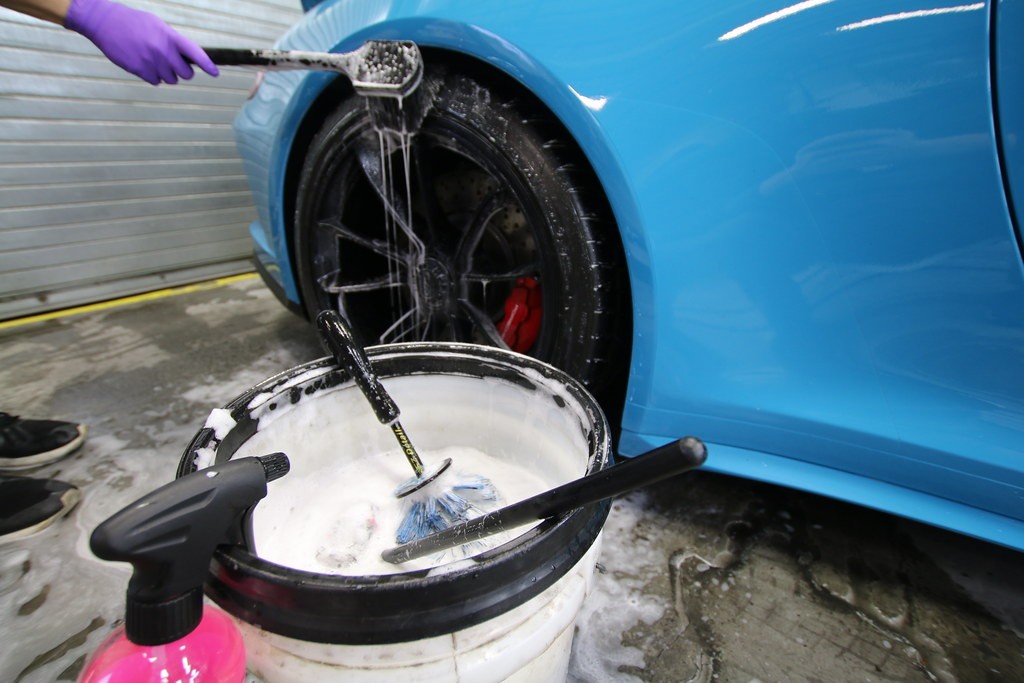
Wheels. Do them last with a separate bucket and their own mitt or brush. Brake dust and salt cake on wheels, and a separate bucket keeps that out of the paint mitt.
When to use a hose wash instead
Rinseless is a winter and light soil tool. When the weather breaks and the spigot thaws, a full two bucket wash with a pH neutral shampoo is still the best way to clean a car with heavy grime. In the shop that is Nanolex Pure Shampoo, which is pH neutral, safe on all surfaces, and will not strip waxes or sealants. The pre rinse and foam stage of a hose wash removes far more grit before the mitt touches the car, and on a car that has been sitting outside through a storm, that is the safer process.
Through the winter, though, a rinseless wash every week or two keeps the salt off the paint and the coating working the way it should. I wrote about the full winter routine for a coated car in driving a coated car through a New Jersey winter. The rinseless wash is the center of that routine.
Frequently asked questions about rinseless washing
Is a rinseless wash the same as a waterless wash?
They are close cousins. A rinseless wash uses a bucket of diluted solution and a mitt. A waterless wash uses a stronger dilution in a spray bottle with towels, on a car that is lightly dusty. Oberk concentrate does both. One cap per gallon for rinseless, four caps per gallon for the spray bottle.
Can you do a rinseless wash in freezing temperatures?
Do it in a garage that is above freezing, with the car warmed to room temperature first. Solution on a frozen panel will ice up and will not clean. If you have no garage, wait for a day above freezing and work in the shade.
Will a rinseless wash scratch my paint?
Done properly, it is one of the safest washes there is. Use plenty of solution, wash one panel at a time, clean the mitt constantly, and dry with a plush towel while the polymer lubrication is still on the surface. Skipping any of those is where scratches come from.
Is Oberk Rinseless safe on ceramic coatings and PPF?
Yes. Oberk lists it as safe for paint, plastics, glass, vinyl decals, and more, and it contains none of the harsh chemicals that shorten a coating's life. On film, wipe along edges and you are fine.
How much Oberk Rinseless do I need per wash?
One cap, half an ounce, per gallon. Two gallons in a bucket is plenty for a sedan, so a 32 ounce bottle covers many washes.
Can I use rinseless wash as a drying aid or clay lube?
Yes. At four caps per gallon it works as a quick detailer and clay lubricant, and Oberk specifically recommends it as a drying aid because the lubrication reduces towel marring. It can also be used as an interior maintenance cleaner for plastic, leather, and vinyl.
Do I need to rinse a rinseless wash off?
No. Oberk says the product can be rinsed off before drying if you want, but they recommend leaving the polymer lubricants on the surface and drying straight from the wash so the towel glides.
Keep the salt off until spring
Salt is the single biggest threat to a car's finish in this part of the country, and the reason most cars come into the shop in April with a dull lower half is that nobody washed them for three months. A bucket, a cap of concentrate, and 45 minutes in the garage every couple of weeks solves that. It is the same process we use here, and it works on a coated Porsche the same as it works on a daily driver.

|
A wash with no hose Oberk Rinseless Wash Concentrate, 32 oz $24.99 · polymer rinseless wash concentrate · one cap per gallon · also a quick detailer and clay lubricant · ships from Norwood, NJ Also in this post: Autofiber Dreadnought, from $25 · Front Line Ready, $24.99 · Nanolex Pure Shampoo, $19.99 |
Phil