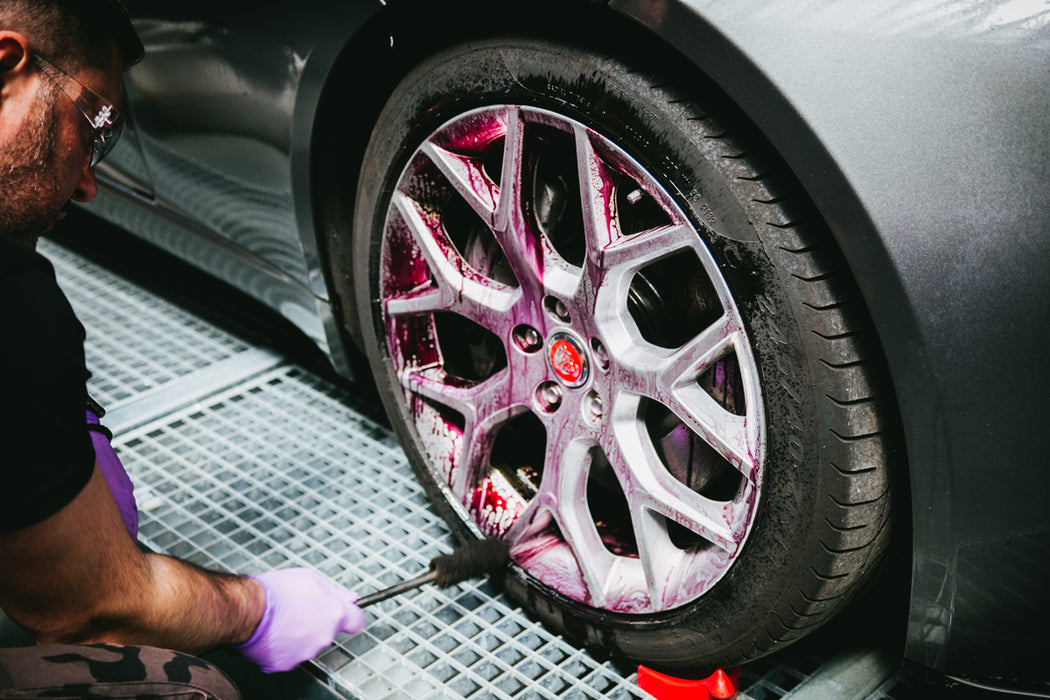
Acid Neutralizer removes all waxes, sealant, silicones, road grime, lot stains and storage stains. Neutralizes acids deposited on the paint surface and in the pores of the paint during transportation and storage. Removes lot stains and wax build-up. Excellent pre-wash for body shops - removes silicones, waxes and other contaminates before sanding. Saves time when applied to used vehicles, removes oxidation, reduces buff time.
Alkaline Neutralizer - Step 2 (or B) - Step II
The second step of our Neutralization System, Alkaline Neutralizer deep-cleans painted surfaces to remove alkaline deposits. Also dissolves ferrous metal particles (rail dust) while breaking their bond to the paint so that they safely and easily float away.
Optional: Detail Wash - Step 3 (or C)
Here are more details on the system...
DESCRIPTION
Paint may be damaged by hot iron particles (dust) that are generated by
manufacturing facilities, rail shipment, etc. and mechanically bond to
a vehicle’s painted surfaces. These particles combined with moisture
and tem- perature create an acid which causes the iron to corrode and
damage (enter) the paint surface.
Paint may also be damaged by industrial fallout and acid rain. These
conditions generate corrosive compounds that fall on the vehicle’s
painted surfaces. When combined with moisture and temperature, chemical
com- pounds are created that damage (etch) the paint surface.
To remove these contaminates, a Decontamination Kit is available which
will repair these concerns.
This kit includes the following items which
will repair up to ten (10) vehicles:
Customers having this concern should have their vehicle repaired using the above kit and the following procedure.
NOTE:
• This repair information supersedes the applicable information located in the PAINT DAMAGE REPAIR GUIDE (9999-95-044N-94).
• No polishing, compounding, color sanding, or repainting should be
done before this procedure is performed. This procedure uses products
that are acidic, alkaline, and neutral and must be properly mixed and
used in their specific order.
• Any changes to this procedure will cause an incomplete or
unsatisfactory repair. The use of other products or procedures may
cause damage to aluminum or painted surfaces.
• The products used to remove surface contamination from paint are
designed for vehicles which have experienced exposure for less than 120
days. Vehicles that exceed 120 days of exposure may require the
procedure be repeated to resolve the concern. Once the procedure is
completed, it may be necessary to perform polishing or refinishing
procedures after vehicle inspection.
REPAIR PROCEDURE
1. Verify customer concern by using a 30X lighted magnifier and the
following descriptions to identifying the type of paint contamination.
IRON PARTICLES
• Light colored vehicles: Small orange stains the size of mechanical pencil lead. The surface is rough to the touch.
• Dark colored vehicles: Small white or silver appearing dots with a
rainbow ring around the dot. The sur- face is rough to the touch.
INDUSTRIAL FALLOUT • Water spots with ferrous metal are present and the surface is rough to the touch.
ACID RAIN / ETCHING • Surface will exhibit irregular discolored spotting.
• Dark colored vehicle may exhibit cloudy or graying spots where the
acid has begun to etch the paint. • Extreme cases of etching will be
visible and may be felt.
2. Decontaminate and neutralize the paint surface by using the Decontamination Kit with the following steps.
NOTE: Perform the procedure only on vehicle when the paint surface
temperature is cool to the touch. Fol- low the step-by-step procedure
listed below, to perform this service operation.
A. Rinseoffdust,dirt,anddebriswithcoldwater.Flushlibe rally. B.
PrepareAcidNeutralizerbymixing8partsofwaterto1part
AcidNeutralizer(ProductA)inabucket. C. Use a clean wash mitt and apply
mixture of Acid Neutralizer (Product A) to the entire vehicle starting
at
the top of the vehicle working toward the side. Keep the vehicle wet
with solution, lightly agitating for 5 to 7 minutes. For vehicle with
severe conditions, work the product for up to 8 minutes. Do not allow
product to dry on vehicle.
NOTE: Use a separate mitt for each product. Do not intermix mitts.
D. Rinse the vehicle thoroughly with cold water to remove Acid
Neutralizer (Product A). E.
Dryonlythehorizontalsurfacesofthevehicleatthistime .Donotdryglass. F.
Apply alkaline Neutralizer (Product B). Do not mix with water. Pour the
contents into a dispenser squirt
bottle. Squirt Alkaline Neutralizer (Product B) directly onto a clean
wash applicator or clean sponge. Do not spray Alkaline Neutralizer
(Product B) on the painted surface. Using the applicator or sponge,
apply the product to the vehicle, keeping the areas wet and lightly
agitated for 5 to 7 minutes. For vehicle with severe conditions, work
the product for up to 8 minutes. Do not allow product to dry on vehicle.
G. Rinsethevehiclethoroughlywithcoldwatertoremovealka
lineneutralizer(ProductB). H.
PrepareDetailWash(ProductC)bymixing29.5mL(1ounce)o
fDetailWashto3.7L(1gallon)ofwater. I. Shampoo the vehicle with Detail
Wash (Product C) using a clean wash mitt. Rinse the vehicle with cold
water and dry the vehicle completely.
NOTE: Detail Wash (Product C) is a heavy duty neutral shampoo
concentrate (pH 7) and may be used for hand car washing or in automatic
car wash systems.
3. Visually inspect paint surface for evidence of removal of iron
particles and water spots. - If iron particles and water spots are
still evident, go back to STEP 2-B and repeat the procedure.
4.
- If iron particles and water spots are not evident, proceed to STEP 4.
Polish the paint surface if necessary.
CAUTION: When attempting to affect a repair by buffing, polishing, or
color sanding, do not remove an excess of 0.3 mil of paint film or
refinishing will be required. Use of an elec- tronic mil gauge is
highly recommended to insure control of paint film removal.
NOTE:
• Do not intermix buffing products. Use only one (1) manufacturer’s
products. • Always follow the manufacturer’s product usage sequence.
Use the appropriate recommended
pad at recommended buffing speeds as specified by the product manufacturer.
• Use a dual action sander with a Velcro backing plate and a foam pad
to fine polish. Remove any swirls created by a rotary buffer or pad.
5. Use an alcohol and water mixture (1 to 1 ratio) to clean the buffed
areas and to verify removal of scratches and swirls before application
of final polish.
6. Verify repair.